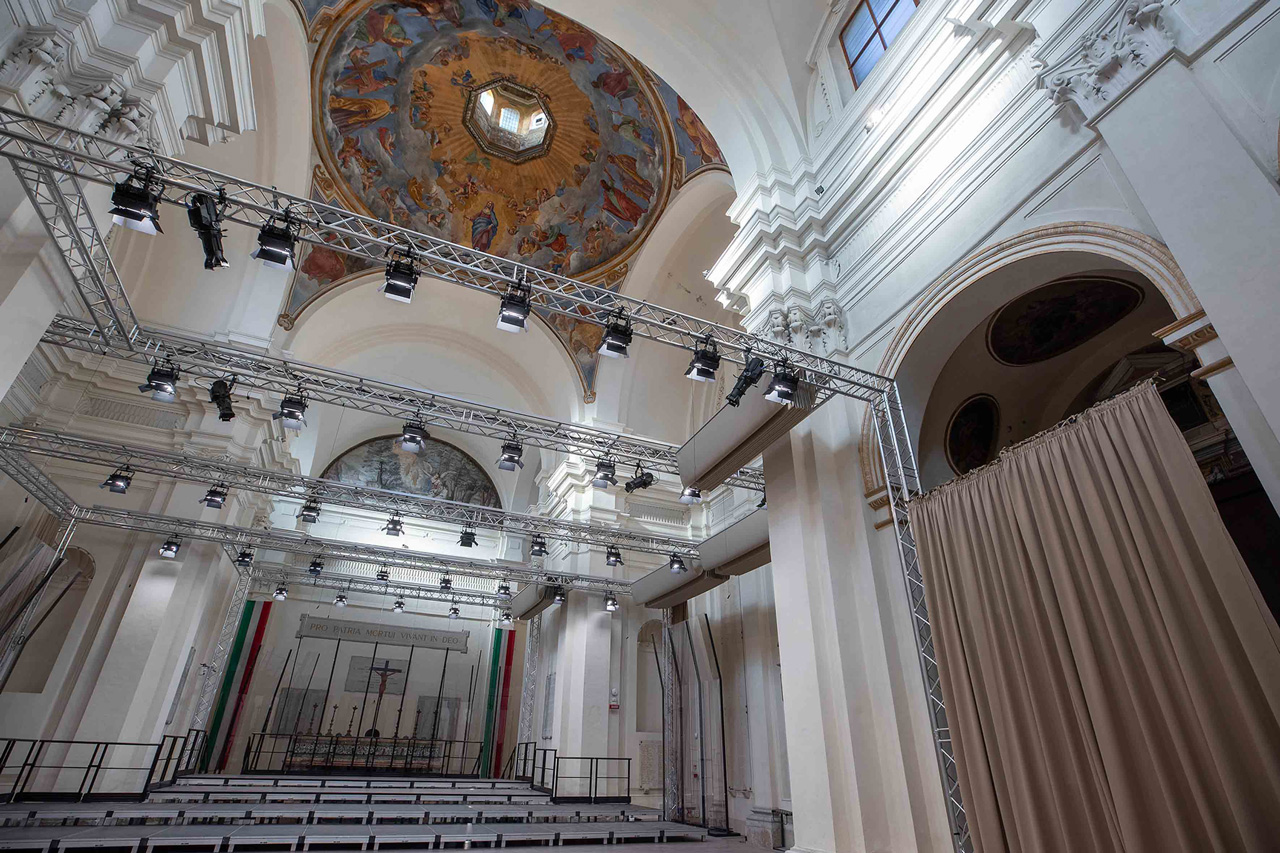
© Emma Graziani
Coro da camera Vikra in residence
Coro da camera Vikra
choirmaster Petra Grassi
music Giovanni Bonato, Johannes Brahms, Ambrož Cˇopi, Luigi Dallapiccola, Jacobus Gallus, Anton Lajovic, Federica Lo Pinto, Pavle Merkù, Claudio Monteverdi, Alessadro Orologio, Hubert Parry, Arvo Pärt, Alfred Schnittke, Georgij Vasil’evicˇ Sviridov, Michele Tadini
Trieste is a frontier city, a cosmopolitan meeting ground for different cultures. Here, the Latin, Slavic and Germanic worlds come together against the vast backdrop of the open sea. While the meeting of peoples often generates confrontation, dialogue and fruitful thinking, Trieste’s history has also been marred by deep and painful wounds, such as those experienced by the Slovenian minority. The Vikra Chamber Choir, in residence at the Festival, is now bridging the gap between Italy and Slovenia. This vocal group from the Trieste Glasbena Matica (“musical homeland”) was founded twelve years ago by the highly acclaimed Petra Grassi, winner of numerous vocal competitions, whose very name evokes the rocky plateau of the Karst (Kras in Slovenian), stretching across the borderlands.
Hailing from Trieste, Gorizia, Udine, Venice, Koper and Ljubljana, the Vikra choir’s repertoire has evolved from an initial focus on Slovenian songs to encompass Renaissance, Romantic and contemporary music. They have committed to new and daring projects, collaborated with many prestigious artists and premiered numerous works, including a score by one of Italy’s most prominent contemporary composers, Michele Tadini. It is with this spirit that the Vikra choir arrives in Ravenna, a city which, like Trieste, overlooks the sea and has a history of openness to exchange and dialogue. The concert programme features works ranging from 16th-century pieces by the Slovenian late Renaissance composer Jacobus Gallus and 17th-century compositions by Claudio Monteverdi, the father of opera and musical theatre, to more contemporary scores by Arvo Pärt, Georgij Vasil’evič Sviridov and Giovanni Bonato, breaking down the boundaries of time, genre and style.
Running time:
1h 15’ without interval